Kostka the Service Dog
People often ask whether Kostka has “service dog paperwork,” or whether a dog this small can really be a service animal. Sometimes there isn’t time for a full answer. Sometimes it’s already a rough day and I don’t have the language or energy to walk through the law on a sidewalk.
This post is meant to do that explaining for me—and to introduce the dog who has been doing this work for several years.
Official guidance: Service Animals — ADA Requirements.
What a service dog is (and is not)
Under the Americans with Disabilities Act (ADA), a service animal means any dog that is individually trained to do work or perform tasks for the benefit of an individual with a disability—including a physical, sensory, psychiatric, intellectual, or other mental disability. Other species of animals, whether wild or domestic, trained or untrained, are not service animals for the purposes of this definition. The work or tasks performed by a service animal must be directly related to the individual’s disability.
In short: it is the trained work or task, not the breed, not the size, and not a certificate hanging on a wall.
(Did you know that under the ADA’s service-animal definition, we’re talking about dogs—with miniature horses addressed separately under a reasonable-modification framework? It’s not “any animal you call a service animal.”)
Work or tasks (examples the ADA lists)
Examples of work or tasks include, but are not limited to:
- assisting individuals who are blind or have low vision with navigation and other tasks
- alerting individuals who are deaf or hard of hearing to the presence of people or sounds
- providing non-violent protection or rescue work
- pulling a wheelchair
- assisting an individual during a seizure
- alerting individuals to the presence of allergens
- retrieving items such as medicine or the telephone
- providing physical support and assistance with balance and stability to individuals with mobility disabilities
- preventing or interrupting impulsive or destructive behaviors in individuals with psychiatric and neurological disabilities
That last category is the one that most directly describes psychiatric service work—including interruption of panic and related spirals.
Service dog vs. emotional support animal
The ADA draws a hard line here:
The crime deterrent effects of an animal’s presence and the provision of emotional support, well-being, comfort, or companionship do not constitute work or tasks for the purposes of this definition.
Presence and comfort alone do not make a service animal under the ADA. Trained tasks that mitigate a disability do. A psychiatric service dog is not the same thing as an emotional support animal under this definition.
There is no official “service dog paperwork”
There is no governing body that certifies a service animal for temperament or behavior as a federal requirement for public access under the ADA. Online “registries” and laminated cards are not what make a dog a service dog.
When the need for the animal is not obvious, staff in places of public accommodation are generally limited in what they may ask—commonly framed as whether the dog is required because of a disability, and what work or task the dog has been trained to perform. They should not be demanding medical records or “papers” as a condition of entry. (Always check current DOJ/ADA guidance for the exact framing of allowed questions.)
Businesses still have rights—and dogs are still dogs
Even a well-trained service dog may still be disruptive or cause damage. They’re dogs, after all.
My understanding of the ADA (not legal advice): a public accommodation may ask that a service animal be removed if the dog is out of control and the handler does not take effective action to control it, or if the dog is not housebroken. Businesses may generally charge for damage the animal causes if they would charge customers for similar damage. The person with the disability can usually still stay and receive goods or services without the animal after a valid removal.
I feel an obligation to advocate for service animals and help people understand both sides: the handler’s rights and the business’s legitimate limits. Rules only work if both are clear.
What Kostka is trained to do
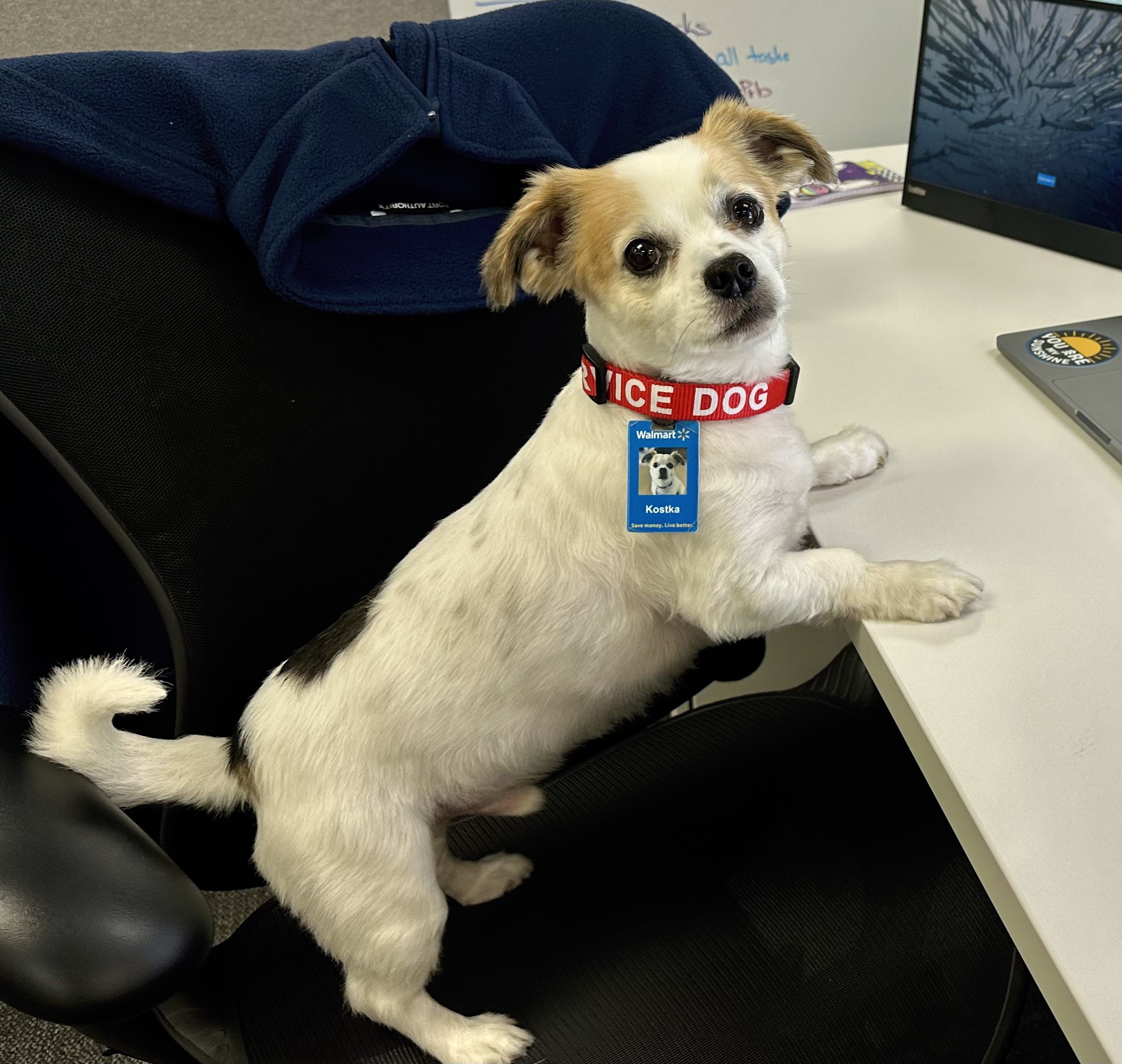
Kostka is a 12.5-pound mutt. He is a maltese bichon shih tzu chihuahua. He has been my service dog for several years.
He is trained (and practiced) to help with anxiety and panic attacks related to PTSD—specifically through pressure and tactile support, and through interrupting me when I am disappearing into my own head.
In practice, that looks like:
- Interruption when a panic or sensory spiral is building
- Tactile stimulation—for example, licking my hands—to give a grounding sensory experience
- Pressure—including offering to sit on my lap—to help keep my mind from locking onto negative, spiraling thoughts
Those are tasks, not “he makes me feel better by existing.” The work is active.
When milder work isn’t enough, he escalates
Service dogs often escalate their interruption or distraction response if the first layer doesn’t land.
Kostka will absolutely initiate play or bark if I am really needing it—when lower-level pressure and tactile work haven’t cut through. That escalation is part of how he pulls me out when things are bad.
That creates a real tension in some environments. At the VA, for example, barking would likely be seen as disruptive, and I am concerned that if it got to that point, someone would ask us to leave—even though the bark can be the exact task that interrupts a psychiatric spiral. Facility signs about calm demeanor and removal for barking or aggression-adjacent behavior stack on top of an already high-stress place to seek care. The burden of that calculation sits with the veteran: bring the dog and risk a task being read as misbehavior, or leave the tool at home when you may need it most.
That gap—between trained task and how the room reads the behavior—is one reason clear public education about service animals matters.
What if someone is allergic to dogs?
People ask whether they can be around Kostka if they are generally allergic to dogs. I keep his coat trimmed short, and he is a house dog, so there is less loose fur to carry pollen or dander into a room. Fur can hold the particles that set off a reaction. It is not itself the allergen. Trimming and his size limit that surface area. They do not guarantee an allergy-free meeting. So far that has been our experience. We have not studied it, so I cannot say it conclusively.
If you want to pet him and you have sensitivities, that choice is yours. Avoid touching your face afterward, and wash your hands.
For hotels, Airbnbs, and other places where cleaning staff may be sensitive, their regular work-safety precautions — gloves, and not touching the face while cleaning — are the right practice and are likely enough. His size and regular grooming already cut the loose coat left in a room. We have traveled a lot, staff have followed those ordinary precautions, and no one has reported a reaction back to us.
At work, his ADA accommodation does not mean someone with an allergy has to be inconvenienced without a second thought. We try to be respectful of other people as we go.
On duty: work, collar, people, and boundaries
Walmart — three-plus years, smallest badge in the company
Kostka has been coming to work with me at Walmart for the last three-plus years. Service dogs are required to wear badges there. Once security folks saw how small he was, they made him a small badge. He has the smallest badge in the entire company.
Collar, leash, and staying by my side
When he is on duty, he wears his service dog collar. We do not always use a leash—the leash can add stress for me, and he is very good about staying by my side. In crowds, you will usually see us leashed.
He may “investigate” people near me by sniffing their ankles. He is building a profile of who is close by and keeping track of my space—not as aggression, and not instead of working. Even while he sniffs, he is still paying attention to my needs.
Petting, food, and who he works for
We don’t mind if others pet him. That is not true of every service animal. Asking first is the right habit; many handlers will say no, and that answer deserves respect. Kostka is not socially motivated, but he is food motivated, so we do not let anyone else feed or reward him. If you do pet him, it is usually only for the two seconds while he is sniffing you. After that, he is simply not interested.
My wife puts it this way: he is a person-dog, not a people-dog. He only cares about Jacob.
Off duty: the real reward is a nose
When we are outside and he is off duty, he is usually off-collar and off-leash.
My main way of rewarding him is not treats. He mostly enjoys treats for the smell anyway. Dogs experience the world primarily nose, then ears, then eyes. Humans tend to experience it eyes, then ears, then nose. For a dog, getting to sniff whatever he is interested in on a walk is closer to what a beautiful landscape—or a high-definition screen—is for us. That kind of reward keeps him paid without training a fat dog.
How we got here: my journey with service animals and Kostka
Why I need the work
I have PTSD from multiple deployments in the Army: twice to Iraq, including the invasion, and once to Afghanistan (2012–2013) as an advisor to an Afghan Army unit.
After years of untreated PTSD, I was in counseling. I had self-sabotaged at my employer and was feeling very low. It was unsafe for me to drive without someone else in the car. Other family members were often unavailable, so I started bringing the dog with me—not yet thinking of him as a service animal, just as a second presence in the vehicle.
The counselor named what was already happening
I’ve had lots of heated counseling sessions, and in one of them I said I thought I could use a service dog: something to help get me out of my head when panic attacks kicked in. She helped me see that this little 12.5-pound mutt was already doing the work a service dog is trained to do—interrupting, offering to sit on my lap, licking my hands so I had a sensory experience that helped pull me off the negative track.
He seemed trained to help me, and I hadn’t fully noticed. Once I did notice, two other parts of the story fell into place: the training background I already had, and the unlikely day he entered my life.
Skills that waited decades
The training piece goes back to my early teens. The family dog I grew up with passed away from old age, and we mourned. Then my mom signed our family up to volunteer with Fidelco, helping train and housebreak seeing-eye dogs. Through that work we learned housebreaking, obedience, and public-facing training. Those skills sat quiet for decades—until I needed them to recognize what Kostka was doing and to finish the job of making him solid in public.
The day I found him
How he showed up is its own story. I got him one day after serving in the Boise Idaho Temple for the Church of Jesus Christ of Latter-day Saints with my wife. After the temple we went to a restaurant, then walked from the restaurant parking lot to a nearby outdoor retailer. In that store’s parking lot, people were selling dogs.
When I saw him, I said that was my dog. We bought him and took him home. That was July 1st; he was roughly five weeks old. At the time of publishing this post, he is nine.
Kostka is a Polish name. It was the middle name of the ancestor I had just done temple service for that day. We named him before we got home so the kids wouldn’t pick something that didn’t fit—if we left it to them, it might have been something like “Acorn.” When his fur is trimmed (I do the grooming), you can see an acorn on his back.
After we had him for about a year, we looked up what Kostka means. It turned out to be an even better name than we first imagined. The word translates as a small stone, or as the large bone in your ankle—so he’s literally an ankle-biter.
Making public access solid
Once the counselor had named the work he was already doing, and once I could draw on those teenage training skills, the remaining job was public access: making sure he was comfortable in many environments. Walmart, day after day, for years, is part of that reality—not a theory of public access, but a practice.
Closing
A service dog is not defined by size, breed, or a piece of paper. Under the ADA, it is defined by trained work or tasks that help someone with a disability. Kostka is a small mutt who interrupts panic, provides pressure and tactile support, escalates when he has to, wears the smallest badge at Walmart, sniffs ankles when he’s on duty, and mostly only wants one person.
If you asked for “paperwork” and got this link instead: thank you for reading. The short version is—task, not paperwork—and the longer version is a life that made that task necessary.